
Will Grade Caps Improve Student Learning?
If you came here for optimist, you must be a new reader...

In recent weeks, Harvard faculty voted to cap A grades to 20% of all course grades beginning in Fall, 2027. This measure has been predictably unpopular with students, but popular with the general public, particularly the kind of online grouches that love anything that turns the screws on the youth1. This is one of those situations where I think both “sides” have some fair points.
First, clearly universities have a problem with grade inflation2. The proportion of Harvard’s A grades rose from something like 25% in 2005 to about 60% today. This is accompanied with other silly stories such as the 55-way tie for top GPA awards at Harvard when, in prior years, only one or two students would typically win.
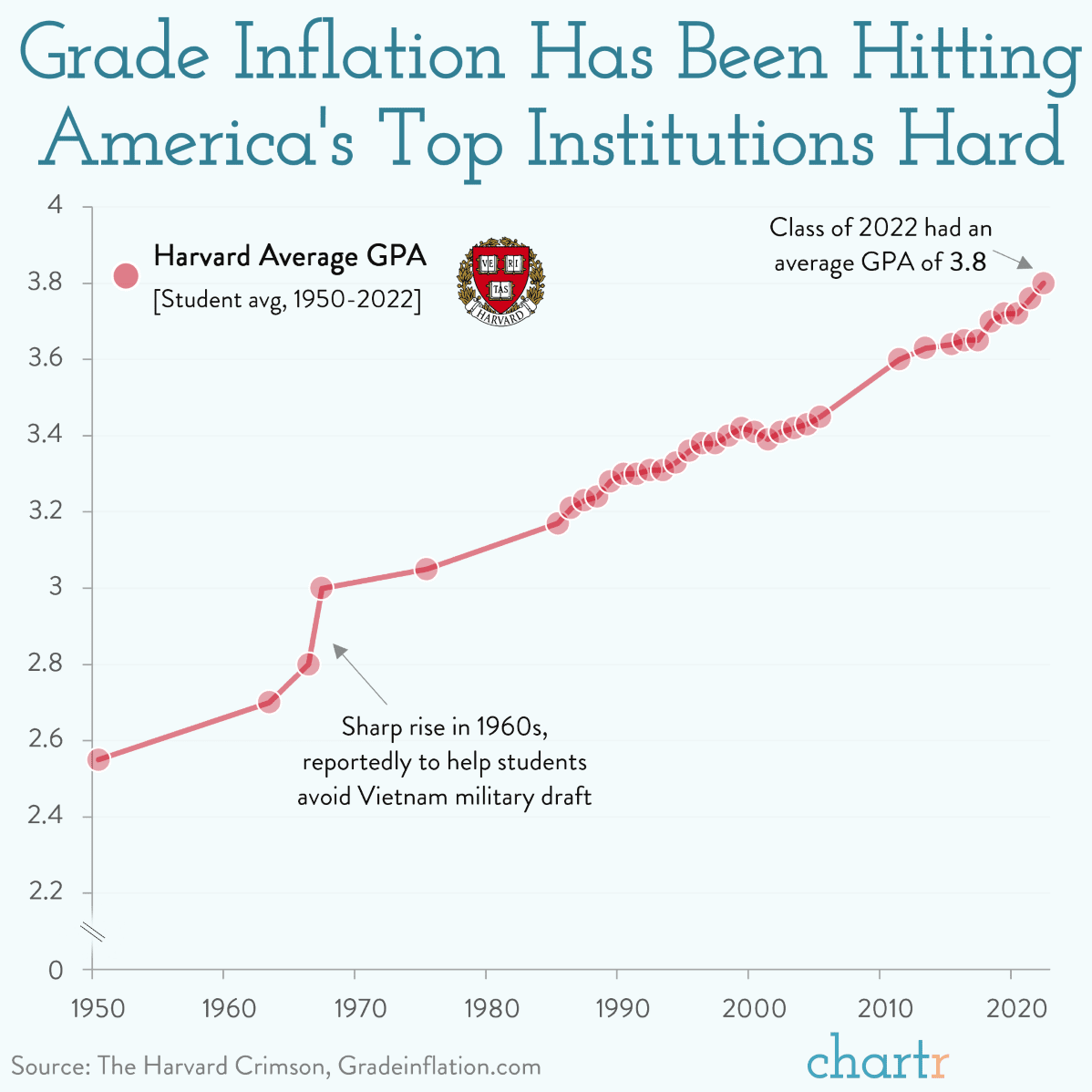
The interesting thing is that grade inflation is obviously nothing new, having begun in the 1960s. Can’t blame this one on the phones. It seems to have begun in the 1960s and continued apace since then.
I think, obviously, there is a very real problem. I think we can reject out of hand the notion that current generations of students are suddenly geniuses3. And though problems may be particularly acute at Harvard and similar Ivy leagues, this probably presents some general problems across universities.
The reasons for this 20-year trend are likely many. Universities have become increasingly bureaucratized and “customer” focused. Allowing student evaluations of teaching to drive faculty job retention and tenure decisions fairly obviously makes faculty wary of pissing students off with low (but perhaps deserved) grades. Everything from Wikipedia to AI4 has torpedoed the robustness of take-home writing assignments (which maybe weren’t great anyway, a topic I may return to).
But so, yes, probably something needed to be done about grade inflation. The trouble is, of course, if one university drops grades, those students may find themselves disadvantaged against students from other universities that don’t. So, Harvard leading the way is a good thing.
At the same time, a % cap is rather crude and, in that sense, students have a point. Why 20%...not 10% or 30%? Is it absolutely impossible that more than 20% of students could obtain mastery in a topic area? Are these grade caps really tied to student learning, or are they just optics to please the general public? I suspect the latter.
Ideally, individual professors would develop an idea of what counts as different levels of mastery for a particular course5. These should be set levels…rigorous to be sure…but achievable by any who put in sustained effort. Different professors may have different notions for what counts as mastery, and different courses might produce different breakdowns of grades. Some courses might have a fairly high proportion of As, whereas others may have none whatsoever. In either case, arguably there should be some sense that the grading was tied to reasonable outcomes and fair. Hypothetically, think about a class in say, airline piloting. True, we’d want a program to weed out the incompetent, but by the time of graduation (for those who aren’t failed out), wouldn’t we want all pilots to be As? Who wants to fly with the C- pilot? On the other hand, perhaps with a course in unsolvable math problems, we’d expect no As whatsoever, assuming all the problems remain unsolved?
An alternative system could use means and standard deviations to create a competitive grading culture. I’m less sure that this works, as it may ironically assign high grades to some who are undeserving (if no students obtain mastery) or unfairly punish the worst of the best (if most all students obtain mastery). Further, if early students drop out, the severity of the curve changes over the life of the course6.
Ultimately, grade caps are understandable, but feel a bit unserious. They seem like throwing red meat to the masses while avoiding any serious consideration of what academic grades are supposed to reflect. How might we get to the latter? Here’s what I suggest:
· Student evaluations of teaching should largely be dropped from faculty evaluations. If faculty receive hordes of complaints, that might be different, but overall SETs produce perverse incentives7.
· Faculty should be incentivized financially for innovative, creative, rigorous teaching.
· Campus bureaucrats should largely get out of the way. Faculty don’t need more trainings, committees, focus groups, etc. They need more time and incentive to think about teaching.
· To some degree we may need to reconceptualize research as well. As of now, faculty burn all kinds of time on least publishable units to get tenure, grants and promotions. Maybe it would be better to slow things down and rebalance teaching and research, with slower more rigorous research as well as more considered teaching.
· Out-of-class assignments need to be reconceived. The take home essay is dead. I’m skeptical blue books8 or oral exams fixes this.
· Applied test questions are better than standard info questions, particularly for any online tests. ChatGPT is pretty clever.
· Faculty need to feel their chairs and deans have their back in the face of student grade complaints. This should be the default. Administration overturning grades should occur only when gross bias or negligence can be demonstrated.
· Accrediting bodies and school rankings should reconsider retention as an indicator of success. This can create perverse incentives for universities to retain every student, however incompetent. Fairness and rigor should replace retention as a metric.
I don’t claim to have all the answers, of course. But I don’t think we’re there yet. So far, too much of the conversation feels a bit unserious, where simply making things harder by default is considered a success9. I think the tell here is so much of the conversation is worrying over “grade inflation” as opposed to student learning. This is the “turn the screws” approach, where students being unhappy is considered a marker of success as opposed to student learning. Perhaps one day we’ll get there but, in the meantime, I suspect grade caps are just an optical bandaid.
Who have a robust presence on X, I’ll note. Love you guys.
As I’ll note “grade inflation” and “students are learning less” aren’t the same thing, though I imagine they are conflated in the minds of many. I think the evidence for grade inflation is pretty clear…whether students are learning less (adjusted for changes in raw ability over time) than 20-30 years ago seems less clear to me.
If anything, the opposite. I believe it was Bob Uttl who showed the the average college student IQ has decline over time as schools have been forced to admit a wide range of increasingly less prepared students in order to pay the bills.
And, if we’re being honest, book reports were killed by Cliffnotes back in the 80s.
I’ll never claim to be the most frightening of professors, but I set different mastery levels for different courses. Interestingly, intro psyche and research methods tend to be my highest fail courses, whereas I’m something of a pussycat in mid-level psyche courses.
I was in one such course in graduate statistics. I get the idea of it, but students who got a B on test 1 would get a D on test 2, not because they got worse in stats but because all the dummies dropped after test 1.
They are largely customer satisfaction surveys. In the end, I do not believe they are biased in racial or gender ways (I don’t think the evidence shows this). But I don’t think they reflect learning either.
Again I think the very appeal of blue books to the grouches is their awfulness. This is replacing actual rigor with optical cruelty.
I see plenty of these “schools should be scarier to kids” or “college should be hard” comments on X. I understand they are responding to a real problem, but they are just as crude and unhelpful.