
Should Screaming Babies Be Allowed in Fancy Restaurants?
One of the endless battles in the parenting wars.

I’ve already criticized flying in coach elsewhere, but I’ll admit one of the worst things about flying, as a light sleeper, is trying to catch a few Zzzs while some naughty baby howls and howls. Can’t anyone give that awful thing laudanum or liquor, I sometimes wonder in my most sleep-deprived, uncharitable moments. But this topic…the inclusion of noisy young children in public life where their nosiness will inadvertently inconvenience others, is a topic of great passions. Many are of the mind that the rest of us should suffer in silence on behalf of poor benighted parents shepherding their little varmints to and fro.
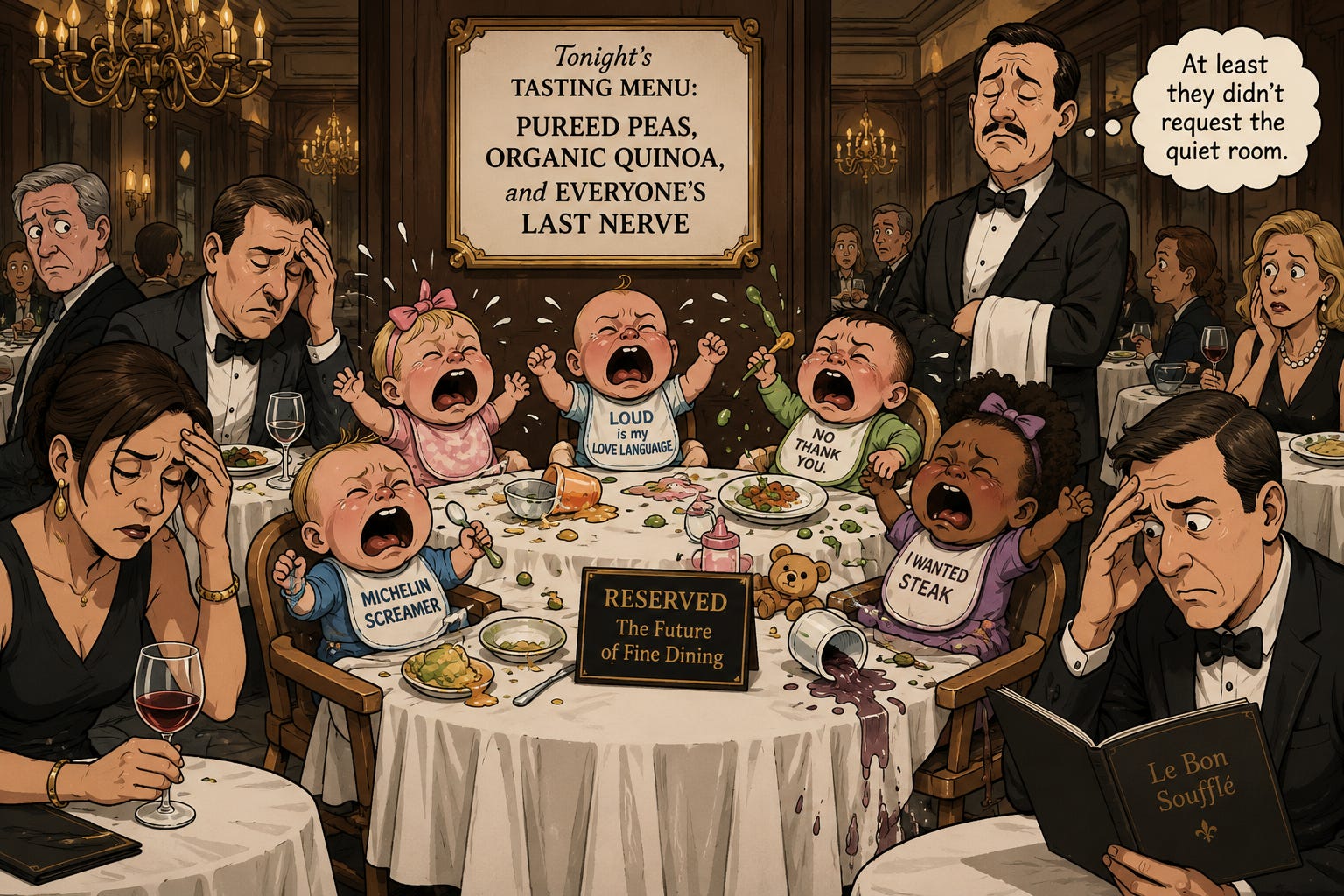
Honestly, I’m not entirely unsympathetic either. Being a parent is tough, controlling young children is a Sisyphean task, and the angry glares of other adults must be stressful. I’ve sometimes wondered if a “family section” to planes might not be an unreasonable answer to this. I could see it as, essentially, the cheap seats where you pay bargain basement prices and, in doing so, lose any right to complain about screaming children near you. Those willing to shell out a few bucks get the halcyon seats, I guess probably closer to the front of the plane.
Expressing this on social media usually invites responses of “You monster!” or the accusation that one is contributing to global depopulation by finding screaming hordes of teething children to be anything other than precious angels. But, it seems, maybe I’m not so alone. A new survey suggests a majority of people (75%)…including a solid majority of parents themselves(79%!) believe children should be excluded from restaurants, at least in some conditions. There are definitely nuances to this…nobody’s trying to kick kids out of McDonald’s, but essentially, later evening, higher concept dining would be more adults only.
When it was released the survey got all the usual howls on social media, but I think they’re kind of on to something. Among flyers, those crying babies aren’t popular either, with the little devils ranking only below seat kicking as the top annoyance of flying. I get the naysayers’ concerns…it’s already stressful being a parent, and some time out in public can be nice. Buuuuut…I generally think the impetus is on the individual causing the disturbance to try to lessen it rather than everyone else to suck it up.
Which is why I think finding some modest compromises could be useful. Specific sections on planes for families doesn’t prevent families from traveling. Having family hours at restaurants doesn’t prevent parents from dining with their kids (but perhaps if you’re going to Maison Lumière, hiring a babysitter isn’t a bad idea?) If you’ve got five unruly kids, maybe Burger King is fine.
Like many issues, this is one where some kind of social compromise is possible. It would help if people didn’t aggressively stake out inflexible moral positions in public. Alas…as with so many things, if only.
I'm going to share a real-life scenario, just as an interesting counter-point to your argument here. My grandfather had a life-long stutter. This was not a cute Biden-esque stutter that lead to meandering conversation points while he worked his way around a difficult word. Instead, he had a severe sound prolongation stutter. His sentences would, every minute or two, go something like this - "so, we went to the store and then A - AAAAAAAAAAAAAAAAAAAAAAAAAAf, and then AAAAAAAAAAAAAAAAAAAAAAAAAAAAAAAAf, then AAA-Afterwards, we went home."
My grandfather was also never a quiet speaker, and his sound prolongations were always louder than his normal speaking voice. Further, as he entered his 50's and 60's, he experienced progressive hearing loss. Like many people with hearing loss, he began speaking louder and louder over time without realizing it and without being able to modulate his volume. Oh, and for extra quirky bonus points, he also had a history of asthma and allergies, and was very sensitive to cigar and cigarette smoke and thus he carried around a battery operated pocket fan that he would take out in a restaurant to blow cigar and cigarette smoke away from him back toward the person who was smoking.
The final relevant bit to this scenario is that after my grandparents divorced, my grandfather got married again to a millionaire, back when being a millionaire meant something (think, frequent fliers on the Concord type of thing), AND he and he wife loved gourmet food. (in case you are wondering, no, we descendants of the first marriage got exactly zero dollars in inheritance from this marriage - even my grandfather was even left essentially high and dry by her family during the last years of his life when he needed board and care support after she had died, despite 25 years of marriage).
Anyway, so imagine you are out enjoying fine cuisine, and my grandfather and his wife come in to the restaurant and are seated at the table next to yours. I guarantee your conversation and the ambience would have been vast more disturbed by my grandfather's extremely loud stutter, loud conversation even when he wasn't stuttering, and him confrontationally pointing a fan at you if you were a diner who liked to smoke with their meal, than it would have been being seated near a young child. But to my knowledge, though I know he got some looks, no one ever asked them to leave, or suggested that they should just eat at home or order takeout. I mean, it wasn't like they weren't sure he would be very loud, or that their "might" be an incident - his eating out was guaranteed to be very noticeably loud to those around him. But again, no one suggested he stay home for the foreseeable future.
So my question is, why not? Why were diners willing to tolerate his presence, but the same diners might have really put their foot down when it came to children?
I'm not on a particular side in this argument, so this isn't really coming from a strong viewpoint one way or the other. I do have kids, and my oldest was enough of a handful that we stopped eating out for a solid 5 to 6 years, even at family restaurants, much less a nicer place, but that decision also wasn't a sacrifice made purely for the sake of deference to the community of quiet-loving adults.
But that is exactly the kind of NUANCE that so many people can't seem to grasp these days! Because it makes too much sense!