
Running With Scissors
Do safety axioms actually make kids behave more responsibly? Also: how much child safety do we really want anyway?

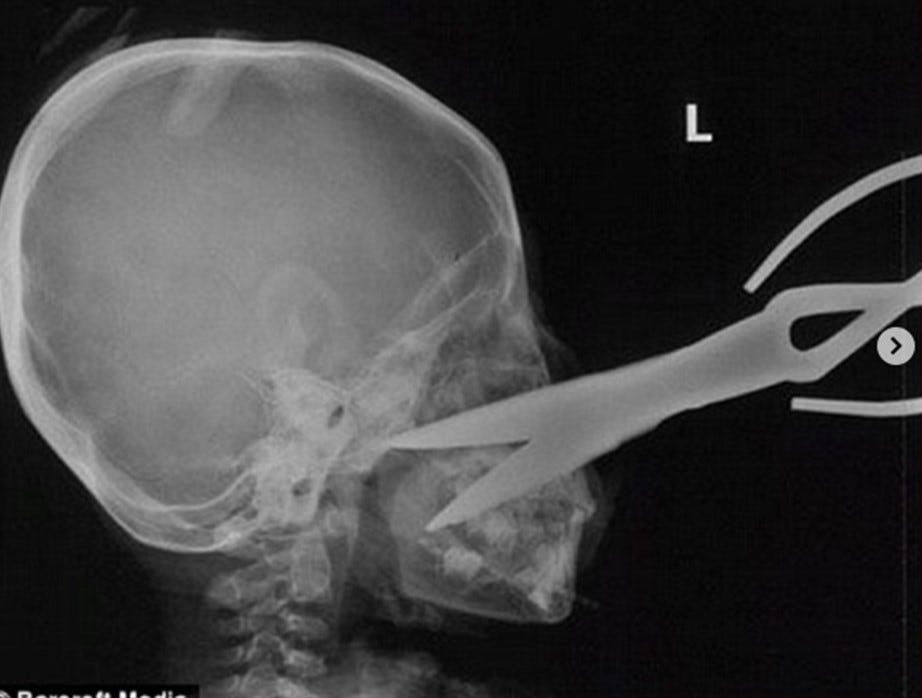
Back somewhere in 2014, a 3-year-old boy made a classic, rookie mistake: running with scissors. This ended the way every kindergarten teacher warns us about: the scissors firmly in his eye socket, penetrating his brain. Fortunately, his injury seemed to resolve miraculously in the ER and, at least according to the medical report, he suffered no immediately evident neurological problems.

Kids are always doing dangerous things. Running with scissors. Running near the pool (sometimes just after having eaten!). Sitting too close to the TV screen (is that even a thing anymore). Sticking their tongues on freezing metal poles in winter. As kids we’re often warned against doing these things: Don’t run with scissors! But do kids listen?

Sadly, there do not appear to be dedicated scissor-injury statistics stretching back to the 1800s giving us even correlational data about scissor injuries over time. Overall, deaths due to unintended injuries/accidents for young children has fallen at least since the 1980s. It’s hard to know why though…is it due to scolding grandmothers and teachers? Is it because products like scissors are now made for kids with safety in mind (think of those blunt, rubber-covered useless scissors they give young kids), or are nervous (and shamed) parents simply bubble-wrapping their kids, keeping them from exploring the outside world at all?
Undoubtedly, kids are safer than they were in the 1970s, when I can remember my grandparents letting me stand in the backseat of their car (I was a small kid), arms on the couch-like front seat, yakking to them as they drove. Though now, in the spirit of “you can’t ever win” many adults today are lamenting all that safety1. Surely, parents are more neurotic and shamed than ever, unable to let their kids into even the front lawn without some kind of Lost in Space robot guardian with them at all time (though even that would be criticized as too much screen time). We now have grumpy adults arguing kids aren’t doing enough underaged drinking and sexing.
But I digress. Does all this warning kids about the dangers of this or that actually work? The answer seems to be no. Kids can learn safety material, recite the mantras, get items on quizzes right. But they don’t apply it in real life. Basically, you can tell kids to stop, drop and roll, but when you test them by setting them on fire (hey, how else are you going to test them?), they run around screaming like everyone else.
For instance, you can tell kids about gun safety. Basically: if you find a gun left in your house by the Gun Fairy, don’t touch it and tell and adult. Then, when the kids are tested by putting them in a room with a real gun (but no real bullets, scientists aren’t psychopaths, or maybe it’s just the IRBs that get in the way of the real fun), they start trying to shoot each other with it just fine (remembering the behavior of some of my early classmates, maybe some of these kids are purposefully trying to settle some scores).
Even with fire safety, big promises are made by activists groups and policy makers promoting them, but outcomes look modest to me (even when parents are involved in developing safety plans). Part of the problem, too, is you can’t cause real fires in participating families’ homes to see how they do (those damn IRBs again!), so we’re never really sure how well outcomes work in practice.
So, most gains, I suspect, come not from teaching kids safety, but simply making the world safer. Kids are now strapped into child seats, not allowed to stand in the back row2 of a Buick Century. Preschool scissors are practically made of Jello. Parents are nearly at the point of inserting RFID tags in their kids before letting them into the yard or playground3. The American Academy of Pediatrics has made it’s own brave stance against bouncy houses, but a world without bouncy houses is not one I want to live in.
But going all in on safety can come with its own downsides. Parents become neurotic and forced to navigate their children’s wishes for autonomy versus societal shame for granting them just that. Youth are robbed of a multitude of adventurous experiences. And we’re all forced to listen to GenXers wave their canes at the sky about how much better things were in the 1970s and 1980s (narrator: “Things were not better in the 1970s and 1980s”)4.
It’s a morbid calculus isn’t it: how many lives do we balance against an increasingly restrictive childhood?
I’ve been amazed by the capacity of adult humans to complain about any outcome even if it is the exact outcome they claimed they wanted 5-10 years ago.
And yes, it was kind of a row.
There are a number of surveys pointing toward increasing restrictive behavior by parents stretching even into teen years. Parents try to deflect blame onto screens, but I suspect parental guilt and shame and fear are the driving force. Parents really can’t win. Send your kids to the park to play, you get the cops called on you. Keep them in your yard, the nightly news will helpfully inform you how many sex predators are lurking in the bushes. Keep them inside, get blamed for “screen time.” Then people wonder why we’re having fewer kids.
Or maybe it’s all just global warming. The summers are getting HOT!
GenX children had some of the worst educational, mental health and behavioral outcomes on record according to government statistics.
As I like to say, it should be "Safety Third". Thinkers as diverse as from Charles Eisenstein (left) all the way to Mike Rowe (right) have argued as much, albeit for different reasons. Not that safety isn't important, it certainly is, but it is not the absolute highest good of all, thus ought not be treated as such. So what is first and second then? My answer is "liberty and justice for all", not necessarily in that order.
Well said overall