
Is Sunscreen Use Associated with Increased Skin Cancers?
A study with bivariate correlations suggest associations may be major, but do they hold once confounders are controlled?

Recently I took my son for a weekend on St. Thomas to enjoy some waves and sun. As a conscientious sun-goer, I slathered myself with reef-safe sunscreen, the kind of stuff that goes on thick and, despite one’s best efforts, stays on for days and days. Only it turns out I’m allergic to some (but not all) reef-safe sunscreens. In this case, though I have some of my own I know work well for me, I opted to save a buck or two and use that provided by the Airbnb host.
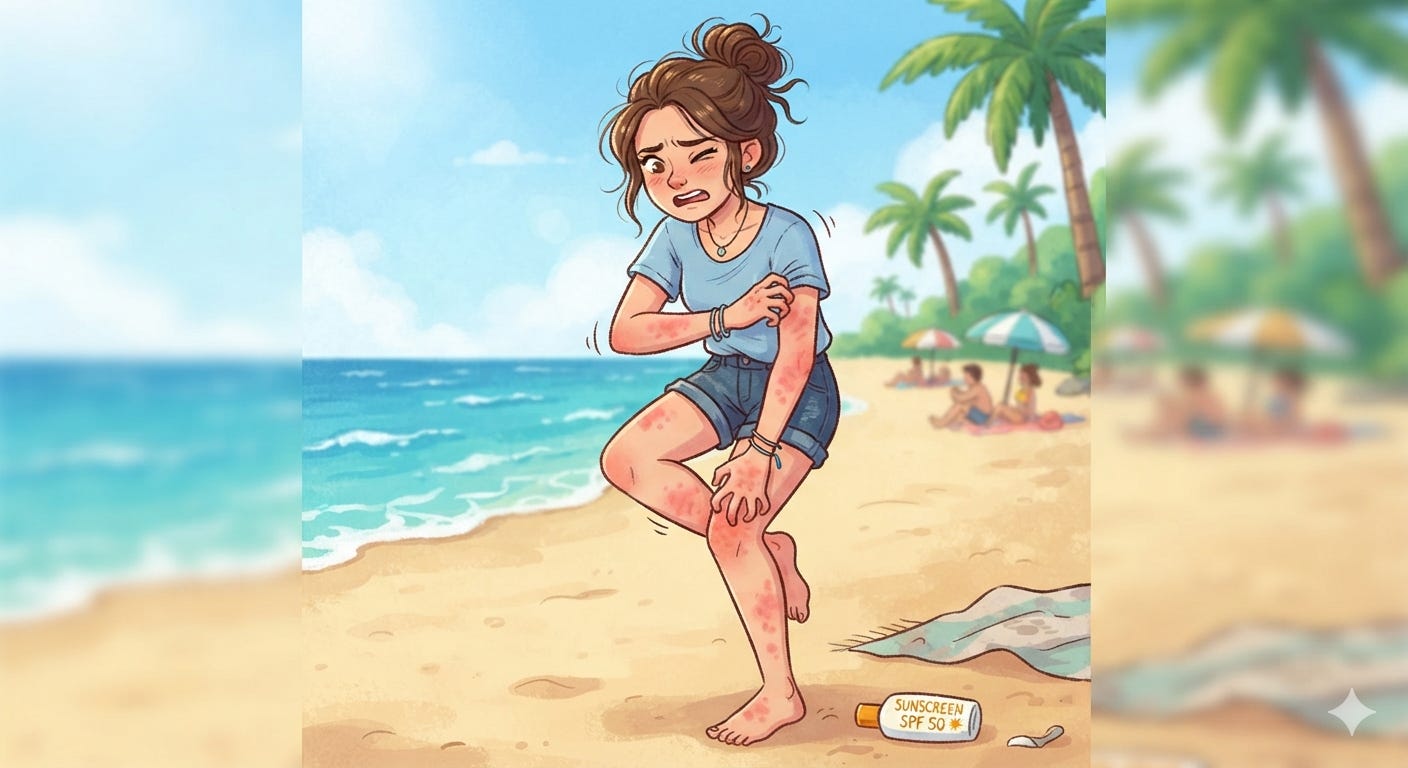
Alas! The cost of those couple bucks has been about two weeks of itchies which have been annoying since, of course, one puts sunscreen on most of one’s body. For some reason, my face doesn’t get the rash at least, but my arms, legs and torso have been angry and red1.
For that reason, I’ve been a bit more alert than maybe I otherwise would be to the weird culture war breaking out about sunscreen. The first salvo came in a report from the Environmental Working Group (EWG) which tests and rates sunscreens on safety and effectiveness. The EWG is very clear in acknowledging that sun exposure causes skin cancer and that effective sunscreens can be a useful protection against these effects. However, they claim that the vast majority of sunscreens are either ineffective or can cause damage to skin. Ironically, they recommend mineral sunscreens like zinc oxide (the reef safe stuff that I’m sometimes allergic to, likely because of a secondary ingredient in some brands). For non-mineral sunscreens they recommend Bemotrizinol, but unfortunately most sunscreens available in the US contain ingredients that are absorbed into the skin and may irritate or damage it (I hear that!)
However, many scientists and dermatologists have rubbished the EWG report, calling it unscientific. Naturally, rather than a debate over science, this has spun into a culture war.
The anti-sunscreen movement appears to be a loose collection of Make America Healthy Again (MAHA) folks, health influencers, and science skeptics. Renowned experts ranging from Robert Kennedy Jr to Gwyneth Paltrow have weighed in on anti-sunscreen and the belief people should have “natural” exposure to sun2.
This movement appears, to me, to combine some plausible and crackpot notions. First, the chemicals in some sunscreens may be absorbed into the skin causing some harm (plausible). Second, there’s a kind of “Big Sunscreen” conspiracy to hide the truth, etc., etc. (maybe a bit plausible but heading into tin foil hat territory). Third, they believe we have evolved to have unfettered access to the sun (forgetting some of us evolved recently in, say, Ireland or Scotland). If one must put something on, maybe try coconut oil or beef tallow (so we’ll end up crispy and delicious). This last clearly goes against well-established research. The EWG, who are not part of MAHA, clearly acknowledge sun exposure causes cancer.
A movement spearheaded by Kennedy and the founder of a company called Goop doesn’t rack up a lot of credibility points at the start. Kennedy, in particular, is the source of plenty of nonsense theories such as Tylenol causing autism. But the theory here isn’t entirely nuts. Even the NYT article I linked above acknowledges that the main chemicals in most sunscreens, oxybenzone and avobenzone, do appear to be absorbed into skin and make it into our urine. Other studies suggest that the chemicals cause endocrine problems in animal studies. There’s no evidence this is harmful for humans, but some of the scientists’ responses in that article did feel a bit defensive and dismissive.
I must pause here to wonder…do I find myself actually defending the plausibility of a crackpot MAHA theory? Allow me to continue.
The controversy sprung up again online when people found an article from 2024 which found that increased sunscreen use is correlated with increased skin cancers. This set up a familiar dynamic with the anti-sunscreen movement. Anti-sunscreen advocates took this as a “worrisome” causal link highlighting the dangers of sunscreen. Skeptics challenged, “correlation doesn’t equal causation!”. But what does the study actually say?
Let’s have a look!
